
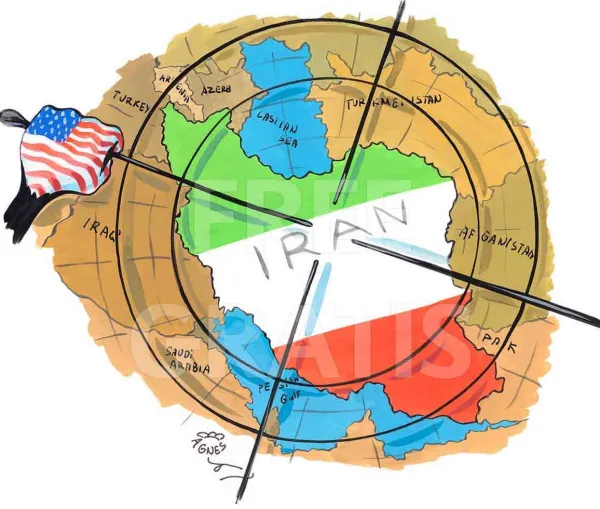
The knives are out—and this time, they are not aimed at Tehran, but at Donald Trump and Benjamin Netanyahu.
Even the ever morally flexible Chris Christie moved quickly. The former New Jersey governor and longtime Republican insider, speaking on CNN, did not merely criticize Trump; he used the moment to indict establishment Republicans for enabling him in the first place. What was once quiet discomfort has now hardened into open political distancing.
CNN, for its part, framed the outcome through a language of selective humanitarian concern—invoking the plight of the Iranian people as victims of their own government, even as it criticized Trump’s failure. The contradiction is telling: a posture of moral superiority that condemns mismanagement, yet stops short of rejecting the underlying logic of war itself. In this framing, aggression is not questioned—only its effectiveness.
Across the Arab world, particularly within Gulf establishment circles, the reaction has been sharper—and deeply revealing. The familiar charge of “cut and run” has returned, recalling the criticism directed at Barack Obama during the US withdrawal from Iraq and the pivot to Asia.
The contradiction is striking: many of the same voices that claimed to oppose the Iraq war were equally outraged when the United States withdrew from it. Then, as now, Washington is faulted not for war itself, but for failing to see it through to a decisive conclusion.
According to Axios, Trump’s decision to pursue a settlement with Iran was made in defiance of strong opposition from key regional allies. Netanyahu resisted. So did several Arab governments whose strategic calculations depended on the continuation—and success—of the war. The pressure was not marginal; it was central. Yet it was overridden.
Netanyahu’s anger is not merely emotional—it is strategic. He understands what is at stake. If this ceasefire holds, and especially if it matures into a permanent agreement between Washington and Tehran, then his long-constructed vision of a “new Middle East” does not simply stall—it collapses.
The conditions that made this war possible—its timing, its alignments, its assumptions—are unlikely to be recreated. This was not just another confrontation. It was a convergence of political opportunity, regional ambition, and ideological fixation. And that moment has now passed.
But this raises a more uncomfortable question: why are Arab governments not welcoming this outcome?
If the war ends, their oil infrastructure is safer. Their economies are more secure. The immediate risk of regional escalation diminishes. By all conventional metrics, this should be a relief.
And yet, it is not.
To understand why, one must look beyond the war itself and into the political architecture that has been taking shape in the region for years. A quiet but powerful convergence has defined Middle Eastern politics: an Israeli-Arab alignment built around the shared objective of containing—and ultimately eliminating—the perceived Iranian threat.
This was not rhetorical. It was financial, political, and strategic.
Hundreds of billions of dollars flowed into Trump’s orbit from regional allies who viewed him as the leader willing to “finish the job.” These same actors deeply resented Barack Obama—not for his militarism, but for what they saw as his failure to go far enough against Iran.
Trump, in their view, represented correction, decisiveness, escalation, and resolution.
They elevated him accordingly, treating him less as a political leader and more as a guarantor of regional transformation. But internal chaos in Washington, followed by the transition to Joe Biden, changed the dynamics entirely.
Still, before leaving office, Trump—guided heavily by his son-in-law, Jared Kushner—engineered one of the most consequential shifts in modern Middle Eastern politics: normalization agreements between Israel and several Arab states.
These agreements did more than normalize relations. They formalized an open alliance—not only against Iran, but also against the Palestinian people and their resistance. They reshaped the region’s political logic.
For a moment, expectations surged. A new Middle East seemed within reach—one aligned with Israeli strategic priorities, one that would position Netanyahu not just as Israel’s leader, but as a central architect of regional order.
Then came October 7.
The Palestinian operation—and the subsequent Israeli genocide in Gaza—did not simply disrupt this trajectory. It exposed its fragility. While the Israeli-Arab alignment did not collapse, its momentum stalled, its legitimacy was questioned, and its future became uncertain.
The Biden administration, along with Secretary of State Antony Blinken, attempted to salvage the framework. The strategy was clear: contain Israel’s battlefield failures while using limited concessions to reignite normalization.
Under Trump’s second administration, this effort intensified. Arab-backed UN initiatives on Gaza—most notably United Nations Security Council Resolution 2803—laid out a framework for post-war governance, including the establishment of the so-called “Board of Peace” as a transitional authority.
Crucially, the resolution also authorized the deployment of an International Stabilization Force (ISF), tasked with securing the territory, overseeing demilitarization, and effectively disarming Palestinian resistance. Together, these measures pointed to a renewed push to impose a regional order from above.
It was within this context that the US-Israeli war on Iran must be understood.
For Netanyahu—and for several Arab governments—it was not optional. It was necessary. As long as Iran remained intact, its network of regional alliances—the axis of resistance—would continue to obstruct the realization of this ‘new Middle East’.
Some Gulf states were initially cautious, not out of restraint, but because they believed they had already secured key strategic gains they could not afford to lose. Syria had been stabilized under a pro-US president. Hezbollah appeared weakened, entangled in internal Lebanese dynamics. Ansarallah was largely held at bay. Gaza, despite its pride and defiance, was being “managed.”
But war changes calculations.
When Iran responded decisively, raising the stakes across the region, the risks became immediate and undeniable. If the war ended without Iran’s defeat, the consequences would be profound: a more emboldened Iran, a recalibrated regional balance, and expectations of major change.
It was then that hesitation gave way to advocacy. Reluctant actors became proponents of escalation—often more so than Trump himself. For them, a ceasefire is not neutrality. It is defeat.
And then Trump unraveled the narrative.
Unable to justify the war, he escalated it—threatening to erase Iranian civilization overnight. This was not bluster but a dangerous extension of an already destructive campaign, invoking the logic of total annihilation and raising the specter of catastrophic escalation.
He boxed himself in with deadlines—issuing them, breaking them, then replacing them with new ones. Each cycle weakened his position further.
The longer the war dragged on, the clearer the reality became: this was not a controlled operation, but a deteriorating campaign.
When Trump escalated his language, he did not project strength—he revealed a loss of control. The illusion of a quick, decisive victory evaporated. In its place emerged a familiar pattern: prolonged conflict, strategic drift, and diminishing returns.
This is Iran’s terrain—not America’s.
Yet two actors ultimately proved decisive: the Iranian people and the American public.
Inside Iran, the anticipated internal collapse never materialized. Instead, society consolidated. Despite immense pressure and loss, public cohesion strengthened the state’s ability to endure. The expectation—shared by Washington and Tel Aviv—of internal unrest simply did not materialize.
At that point, Trump’s rhetoric shifted again—from claiming to “save” Iranians to threatening their annihilation. This was not strategy. It revealed a profound loss of judgment.
In the United States, the outcome was equally significant. At no point did the American public demonstrate sustained support for the war. Poll after poll failed to produce the desired shift. Opposition remained consistent—and deepened, particularly against any prospect of ground invasion.
This cannot be overstated. Without public backing, prolonged war becomes politically unsustainable.
Under these conditions, the question of who “won” is, at this stage, premature—and perhaps beside the point.
Iran did not initiate the war. It remained in a position of self-defense—and succeeded in preserving its territory, its people, and its resources.
The same cannot be said for Trump or Netanyahu.
For Netanyahu in particular, the stakes were existential. This was meant to be the decisive confrontation—the moment that would eliminate his strongest adversaries, secure Israeli supremacy, and give substance to his long-articulated vision of a “Greater Israel.”
That project is now under strain.
The coming days and weeks are decisive, for an outcome of this magnitude cannot pass without major geopolitical consequences—regionally and globally.
Israel and the US will attempt to reinterpret events to save face and revive their project of dominance. Arab media—particularly in the Gulf—will work to minimize what Iran sees as victory.
But in the final analysis, none of that will matter.
What will matter is what history records:
· Israel and the US failed to defeat Iran.
· They failed to achieve regime change.
· They failed to destabilize the country from within.
· They failed to fracture the axis of resistance.
· They failed—even—to impose their will by force in the Strait of Hormuz.
The question that remains is unavoidable: will Arab governments continue to anchor themselves to a failing Israeli-American project?
Or will they recalibrate—before the region is reshaped without them, and a new Middle East emerges not as Netanyahu envisioned, but as defined by the endurance of its people—from Gaza to Beirut to Tehran, to Sanaa?
- Dr. Ramzy Baroud is a journalist, author and the Editor of The Palestine Chronicle. He is the author of six books. His latest, ‘Before the Flood,’ was published by Seven Stories Press. His other books include ‘Our Vision for Liberation’, ‘My Father was a Freedom Fighter’ and ‘The Last Earth’. Baroud is a Non-resident Senior Research Fellow at the Center for Islam and Global Affairs (CIGA). His website is www.ramzybaroud.net
--
Dr. Ramzy Baroud
PO Box 196, Mountlake Terrace, WA 98043
E: info@ramzybaroud,net - ramzybaroud@gmail.com
Twitter: @RamzyBaroud. Website: www.RamzyBaroud.net